How can I convert other image file types to webp format via context menu?
2 Likes
You'd need to employ an external converter like ImageMagick.
yeah I know and have the external tools, but I think DO is not friendly with webp which is the best image format. It's better for DO developers to implement this format like other image formats.
HM, probably way off again, but for .webp it works just fine:
- Double click on the picture file
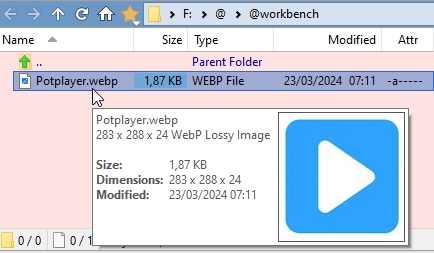
- In the picture displayed, select in the menu File -> Save As ...
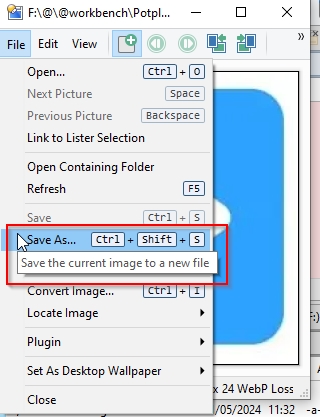
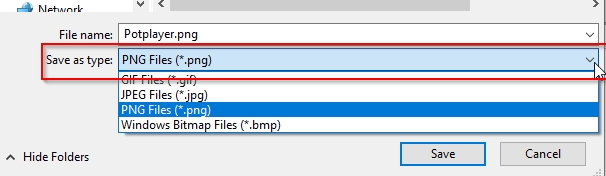
- You can also choose a pic format. Enjoy a converted webp

OR 
-
Double click on the picture file
(See above) -
Right click on the picture and select CopyAll
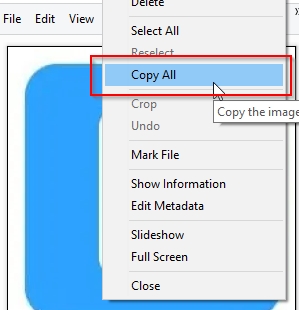
- Now close both the right-click menu and the pic, CTRL+V the clipboard into the folder (right-click paste works as well , and receive your converted "Clipboard Image.jpg"
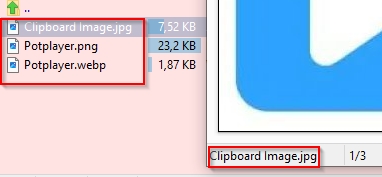
Of course, pressing CTRL+SHIFT+S in the opened pic works also ...
I mean converting other image types to webp not webp to other image file types. It seems you didn't read the Q carefully.
1 Like
How right you are, It's these old eyes, you know  I crawl in the dust Thanks for pointing it out. So it's back to external tools like
Works like a charm
I was about to open a thread and bumped into this one. Soooo, does that mean until today, I can’t get Opus to do JPG to WebP natively? Like to have it show up in that conversion window? No?
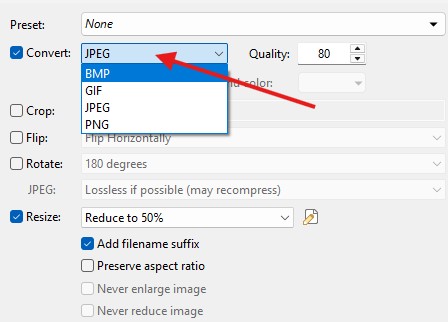
WebP is read-only in Opus, at least currently.
You can use tools like ImageMagick to create a button in Opus that converts things to WebP.
Dang! Bummer. OK, I guess I’ll have to go the ImageMagick route then.
I’m curious though, is that a licensing issue, patent, registration bottleneck or something with other legal barriers that stopping GPSoftware from being able to add such feature natively to Opus? There are so many other apps, some way smaller than Opus that have WebP implemented a long time ago. So, as an avid user of Opus, I wonder why!
Opus has support for the main image formats, we can't add every single niche format that comes along 
1 Like
Come on now, let’s not make this what it isn’t. A format that was introduced in 2010? So, we’re at 15 years by now. As a web designer, I’ll say that’s total bullocks to categorize WebP as “niche” because it has widespread adoption across various platforms. Yes, it has its critics and doubts to ever truly replace JPG and PNG. However, as we speak, it is supported by all major browsers. And just about all design software (Affinity, Photoshop/Illustrator, CorelDraw, Krita, etc…) at some point has implemented support to export as WebP.
So, at 6:11 PM Eastern Time on 8/21/2025, there’s no way a developer can sit straight and wrote to me that the WebP format is currently “niche” and for me to not reply: THAT’S NOT TRUE!
Hello
I asked this question a few months ago, but after this long time, DO hasn’t updated with this feature, nor has it addressed a bug I reported.
AVIF is the best and newest image file format, which is superior to WEBP.
These 2 image formats are known as modern image formats that DO doesn’t fully support them.
ImageMagick | Mastering Digital Image Alchemy
These are the buttons/commands that can be used :
magick {filepath$} {filepath|ext=avif}
magick {filepath$} {filepath|ext=webp}
You’re already telling us WebP isn’t as good as AVIF, which you want instead or as well. (Opus supports reading both, but writing isn’t built-in. Easily done using ImageMagick, though.)
Other “modern formats” include HEIC, JPEG XL, JPEG 2000, UltraHDR, OpenEXR, and a bunch of others.
We support some of them as read-only but it’s hard to devote time to supporting all of them with full read/write support and metadata. A new format comes along every year and all the people into new formats jump ship and want the very newest one, making it feel like a waste of time implementing the previous format.
Almost all of the formats are badly designed, with no regard for making it easier by using existing container and metadata formats, or having an API that’s standard across multiple formats. Each instead requires custom work with a completely different library and API.
The people coming up with this endless list of new image formats do so based on whims and short-term needs without any cooperation or planning for what anyone else may need. (If they did things properly, we’d all be working on a future with just one new format, not an ever-increasing number of failed formats everyone hates.)
None of them have actually taken off outside of ecosystems where people are forced to use them by hardware companies.
Both Apple (HEIC and JPEG XL) and Google (WebP and UltraHDR) are forcing people to use multiple formats right now, because they were too incompetent to add all the features they needed into a single format. It’s completely ridiculous.
If there’s an unfixed bug, remind us what it is and maybe we can fix it.
7 Likes
DO is the most advanced file explorer for Windows, but unfortunately, the team behind it doesn’t welcome users’ feedback.
1. About the modern image format, we don’t mean using an external library like ImageMagick. They are not niche formats. We want it to be built into DO. These modern image formats are not for this year or last year. They’re from many years ago, and your developers have had enough time to implement them. Just look at how browsers/OSs/image-related software support them.
WebP is excellent, but the AVIF format, which is from “Alliance for Open Media“.
You can learn more about it and its advantages over other image formats, including the formats you mentioned.
“AV1 Image File Format (AVIF) is an open, royalty-free image file format specification for storing images or image sequences compressed with AV1 in the HEIF container format.[1][2] It competes with HEIC, which uses the same container format built upon ISOBMFF, but HEVC for compression. Version 1.0.0 of the AVIF specification was finalized in February 2019. Version 1.1.0 was finalized in April 2022.
In several tests conducted by Netflix in 2020, AVIF demonstrated better compression efficiency than JPEG, as well as improved detail preservation, reduced blocking artifacts, and less color bleeding around hard edges in composites of natural images, text, and graphics.[3]
According to the website caniuse.com, AVIF support is available in all the major web browsers (accounting for over 93% of all web browsers by use).[4]“
2. About the bug that you blame Windows OS for, your answers weren’t convincing. A major bug in RTL languages file path
While I do agree that webp is a common image format on the web, I find the tone that some users are using in this thread irritating… 
(Btw, as a side note: not every developer is a web developer; and many developers have never had to work with webp yet.  )
)
1 Like
As a general statement that's ridiculous. They may not agree to implement every request, but every day I read that some requested capability will be added to the next beta.
Most of the time I don't understand what's being asked for, but it's obvious to me that feedback and requests are being welcomed all the time.
6 Likes
Could you elaborate on the difference between having it built-in and using an external tool which call can be configured in a button or a script?
More specifically, could you point out what could not be done in the later?
PS: To complement @rcoleman1943 and @dpuser441 posts above, I would add that I’m not convinced that kind of tone will help you getting what you seem to want.
2 Likes